More than once, a student has asked, “Ms. R, what is irony?” It’s actually not that easy to answer on the fly. But recently, I was a given a unique opportunity. It was, as teachers like to say, “A teachable moment!” This is another way of saying, “Fuuuuuuuuck! It’s all gone to shit!!!!”
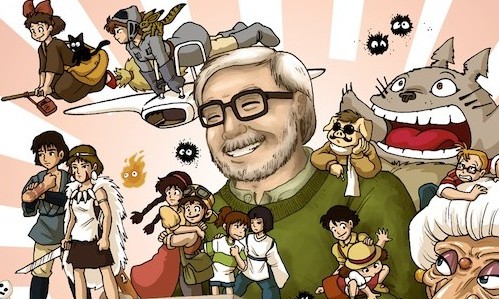
It was late morning. I am currently in the middle of teaching a unit on the great Japanese anime film artist and producer, Hayao Miyazaki. Each week we study one of Miyazaki’s films and analyze the theme, metaphors, and symbolism. Sprinkled throughout, we read scholarly articles, interviews, reviews and the like. Last week we watched part of a documentary, The Kingdom of Dreams and Madness, about Miyazaki and his production studio, Studio Ghibli. It was fascinating to see Miyazaki at work, sketching film frames by hand, explaining his process. The film focused on Miyazaki’s political views and the social commentary that can be found in several of his films.
One scene was particularly poignant where Miyazaki talks about why, after the release of his last film, The Wind Rises, he will retire. He begins speaking about today’s youth and how disconnected they are from the real world and how he feels that his tireless work no longer reaches his audience. As he speaks, the camera shows Miyazaki alone in a train station, standing on a platform, while all around him young people play on their phones, take selfies, listen to music with headphones stuffed in their ears, faces pressed to iPads. It was a sobering scene. I was so engrossed, that it took me a moment to notice that literally EVERY student in the classroom (save one, bless him) was on a device. I looked for a long few minutes hoping someone would look up at the screen. No one did.
Tears welled in my eyes as I walked to the media cart and paused the film. Big breath. Wait for it…..
“Tragic Irony!” I intoned. “This is an example.” (example..example…example…) ((echo))
A few students looked up, but most continued along in their media world. I stood for several seconds and then in my teacheriest voice I said bravely, “Put your phones face down on the tables, ear buds out, laptops shut.” Slowly they complied and looked vacantly up at me.
“Do you know how lucky you are?” Blank stares. “You signed up for this class because you value the work of Hayao Miyazaki. We can all agree that his films speak to so many of us because his films are masterful and meaningful.” I paused. “And yet we just learned, in this film, that he will no longer be making movies. He is done. Can anyone tell me why?” Radio silence. They got an inkling that something was up.
I went on to explain to the class in detail the very scene that they had just missed. I painted them the picture of Miyazaki standing alone on the platform while all around him the world checked out. I further described the scene within the classroom during this moving moment in the film. A few students looked appropriately chagrined, but most still seemed confused. I changed tactics.
“Why are you here?” I asked.
There was some laughter, some sighing, a groan. I waited.
“To get credit.” someone called out.
“To watch movies?” a girls asked.
“To sleep!” a smart ass declared.
“Funny.” I replied, “I kinda thought you were here to learn.”
One of my sassier girls retorted, “Well first of all, you didn’t give us questions for the film or tell us to take notes, and second, it’s in Japanese and subtitles are hard to read.”
“Well they certainly are when you are looking at your phone and not the screen. Listen guys, learning is not just about…. wah wah wah wah wah……..” I would love to write out this lecture word for word so you too could be summarily swayed as my student assuredly were.
I’m sure you get the gist of my rebuke. It was a gentle but impassioned lecture about learning and engagement and motivation and future and connection.”It’s not for credit, by GOD!”
I maybe reached one or two. Plus the guy who was watching in the first place. (Bless him)
Needless to say it was a most definitely a “Fuuuuuuck! It’s gone to shit!” moment.
But there is a silver lining! I found our teachable moment and we were able to get a really great working definition for tragic irony:
noun

 Faking it.